
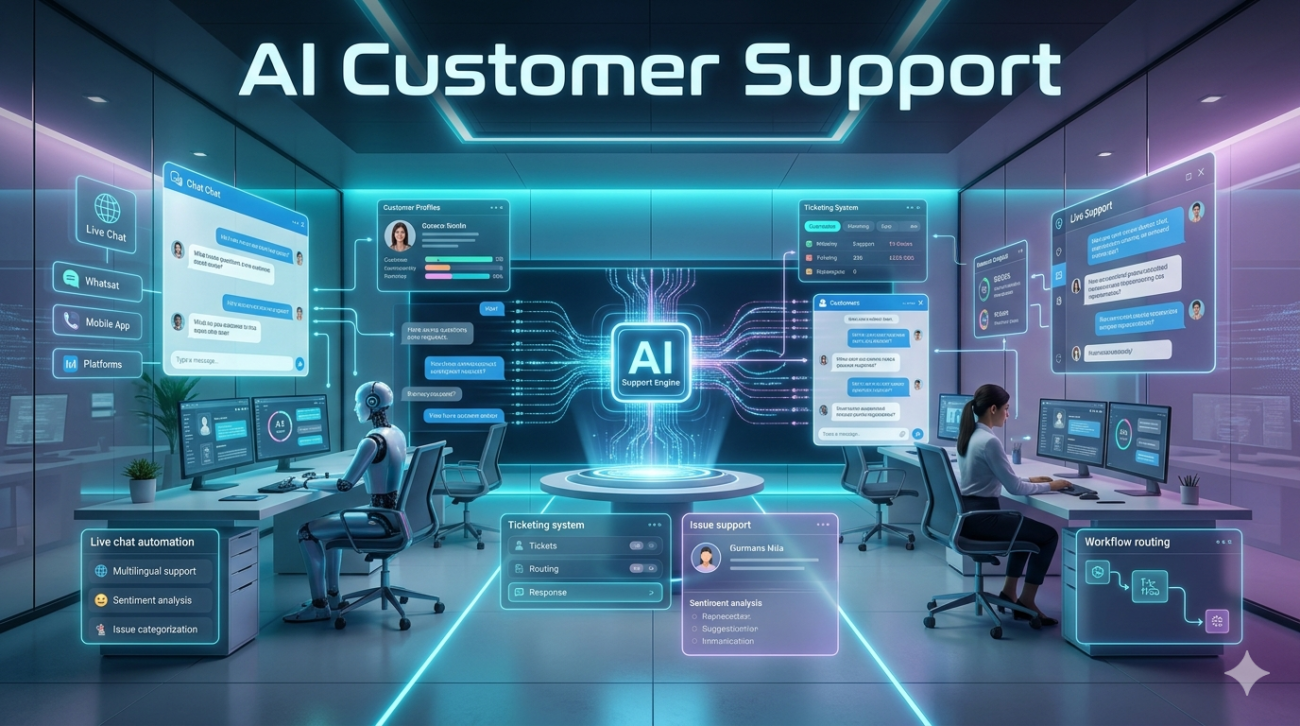
I still remember the headache of deploying my first automated customer service bot about seven years ago. It was essentially a glorified decision tree. If a customer typed anything outside of ten rigid keywords, the bot would spit out a frustrating, I’m sorry, I didn’t understand that. It didn’t solve problems; it just raised our customer churn rate and gave our live agents a backlog of furious users. Fast forward to today, and the landscape of AI customer support has completely transformed. We aren’t talking about rigid scripts anymore.
Today’s generative AI and Large Language Model (LLM)-powered platforms can parse nuanced conversational context, detect frustration, look up shipping logistics in real-time, and issue refunds before a human agent even finishes their morning coffee. But having spent years consulting on support tech stacks and watching companies navigate this transition, I can tell you that AI support isn’t a magic wand. It’s a powerful, sometimes volatile tool that requires a strategic balance between automation and authentic human touch.
From Scripts to Smarts: How We Got Here

To understand where we are, it helps to look at how the technology evolved. Older chatbots relied on Natural Language Processing (NLP) that looked for specific syntax. If you asked, Where is my package? it worked. If you said, My porch is empty but the app says delivered, it broke down. Today’s AI customer support tools run on semantic understanding.
They ingest your entire company knowledge base past ticketing histories, internal PDFs, return policy documentation and synthesize custom answers on the fly. This shift has unlocked what industry veterans call true ticket deflection. We aren’t just deflecting customers away from human agents; we are actually resolving their issues autonomously at scale.
Where AI Shines: The Ultimate Triage Engine
In any customer support operation, roughly 60% to 70% of inbound volume consists of repetitive Tier-1 inquiries. “How do I reset my password?” “What’s your return window?” “Can I change my billing address?”
When you deploy AI to handle these transactional requests, two wonderful things happen:
- Instant Gratification: Customers get accurate answers at 2:00 AM on a Sunday without waiting in a queue.
- Agent Relief: Your human agents are freed from the soul-crushing monotony of copying and pasting tracking links for eight hours a day.
A Realistic Case Study: The Holiday Scaling Crisis
Consider a mid-sized direct-to-consumer cookware brand I worked with. Every Q4, their ticket volume spiked by 400%. Historically, they solved this by hiring seasonal temp agents. It was expensive, onboarding was rushed, and quality suffered.
Last year, they integrated an AI support assistant tied directly into their Shopify and inventory management systems. We trained the AI specifically on holiday shipping cutoffs and warranty claims.
The results were eye-opening. The AI handled 68% of all Q4 chats end-to-end. Average resolution time dropped from 14 hours to under three minutes. But the real win was for the human team. Because the AI absorbed the flood of “Where is my order?” inquiries, the seasoned human agents had the bandwidth to handle high-stakes issues like a damaged package arriving days before a customer’s wedding.
The Elephant in the Room: Limitations and Ethics
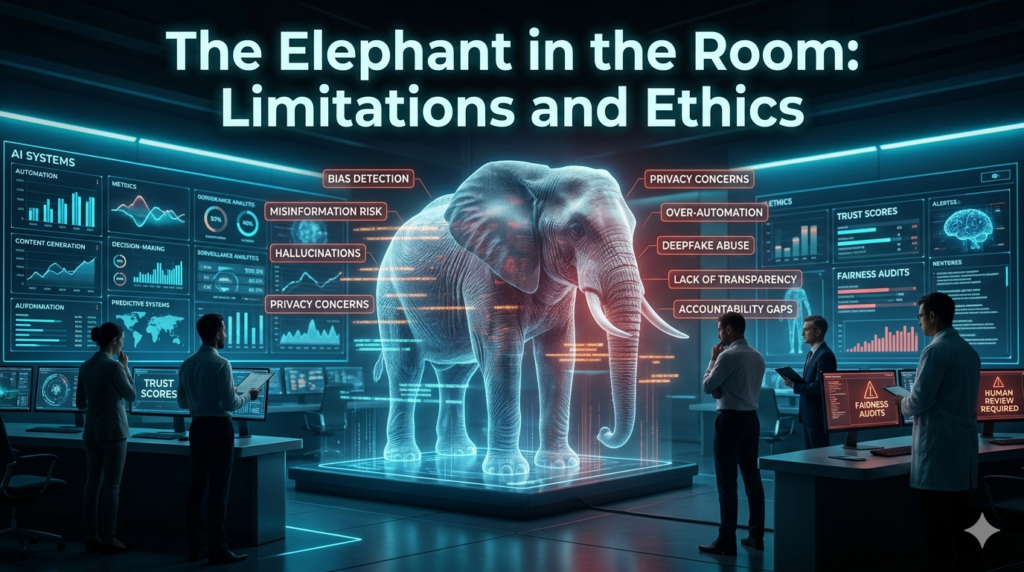
If anyone tells you AI can fully replace your customer support department, walk away. They are trying to sell you software, not solve your business problems. Demonstrating expertise in this field requires acknowledging where the technology fails.
1. The Empathy Deficit
AI can simulate empathy, but it cannot feel it. When a customer is contacting support because their bank account was wrongfully locked while traveling abroad, receiving a perfectly crafted, AI-generated “I understand how frustrating this must be” often feels patronizing. High-emotion, high-stakes scenarios require a human being who can listen, validate, and apply nuance that goes beyond company policy.
2. Hallucinations and Confident Errors
Generative AI is designed to sound confident, even when it’s wrong. If your AI support bot isn’t strictly guardrailed by grounded data architecture (often called Retrieval-Augmented Generation, or RAG), it might invent a refund policy or promise a feature your product doesn’t have. In customer service, a confident lie is infinitely worse than an honest “I don’t know.”
3. Data Privacy and Security
When customers interact with support, they routinely drop sensitive information into chat boxes credit card numbers, social security digits, health details. Businesses must ensure their AI support tools are SOC 2 compliant and do not use customer data to train public models.
The Playbook: How to Implement AI Support Correctly
If you’re gearing up to integrate AI into your customer service workflow, don’t rush into a plug-and-play launch. Treat it like onboarding a new human employee.
- Audit Your Knowledge Base First: AI is only as good as the data it feeds on. If your internal FAQ has conflicting return policies from 2021 and 2023, the AI will get confused. Clean your documentation before deploying a bot.
- Build the “Escape Hatch”: Never trap a customer in an AI loop. There must always be a clear, frictionless path to reach a human agent. I recommend setting sentiment analysis triggers; if the AI detects profanity or repeated phrasing (indicating frustration), it should immediately route the ticket to a human with the complete chat transcript attached.
- Empower Agents as Copilots: AI isn’t just for customer-facing widgets. Some of the best implementations I’ve seen use AI internally. While a human agent is chatting with a customer, the AI operates in the background, drafting suggested replies and instantly pulling up relevant account data. This keeps the human in the driver’s seat while supercharging their efficiency.
The Future of Customer Support
We are moving away from customer support as a cost center and toward support as an engine for customer loyalty. The companies that win in this new era won’t be the ones that automate 100% of their staff away. The winners will be the organizations that use AI to handle the predictable, repeatable tasks, thereby carving out time and budget for human agents to deliver concierge-level service when it matters most. It’s not about Human vs. AI; it’s about Human aided by AI.
FAQs
Q: Will AI customer support replace human customer service agents?
A: No. While AI will significantly reduce the need for agents to handle basic, repetitive queries, human agents will remain vital for complex problem-solving, emotional de-escalation, and high-value customer relationships. The role of the agent is evolving from data retriever to empathy specialist.
Q: Is AI customer support feasible for small businesses, or just enterprise companies?
A: It is highly feasible for small businesses. Modern AI support tools integrate seamlessly into platforms like Zendesk, Intercom, and Shopify at affordable price points. They allow small teams to punch above their weight and offer 24/7 support without hiring night-shift staff.
Q: How does AI handle multilingual customer support?
A: Modern LLM-based AI platforms excel at real-time translation. They can instantly detect the language of an incoming query, translate it to check the company knowledge base, and respond fluably in the customer’s native language, maintaining colloquial accuracy better than older translation tools.
Q: What is “ticket deflection” and why is it important?
A: Ticket deflection measures the percentage of customer inquiries resolved by self-service or AI without requiring human agent intervention. It is a crucial metric because it lowers support costs, reduces agent burnout, and gives customers immediate resolutions.
Q: How do I stop my AI support bot from giving incorrect information?
A: You need to utilize strict data grounding (RAG architecture) that forces the AI to answer only from your approved knowledge base. Additionally, you should configure the system to escalate to a human rather than guessing when it encounters a scenario outside its training data.
