

AI writing tools have moved from neat experiment to everyday workhorse in marketing teams, newsrooms, agencies, HR departments, and small businesses. If you write for a living or even if writing is just one part of your job you’ve probably felt the pull: faster drafts, fewer blank-page moments, and the ability to spin one idea into ten formats in an afternoon. But there’s a second, quieter reality: the same tools that can save you hours can also flood your site with generic copy, introduce factual errors, and sand down the voice that makes your brand recognizable.
The difference isn’t the model. It’s the workflow. This article breaks down what AI writing tools actually do, the best use cases (and the risky ones), what to look for when choosing a tool, and a practical way to integrate them into a responsible content process.
What counts as an “AI writing tool” today?
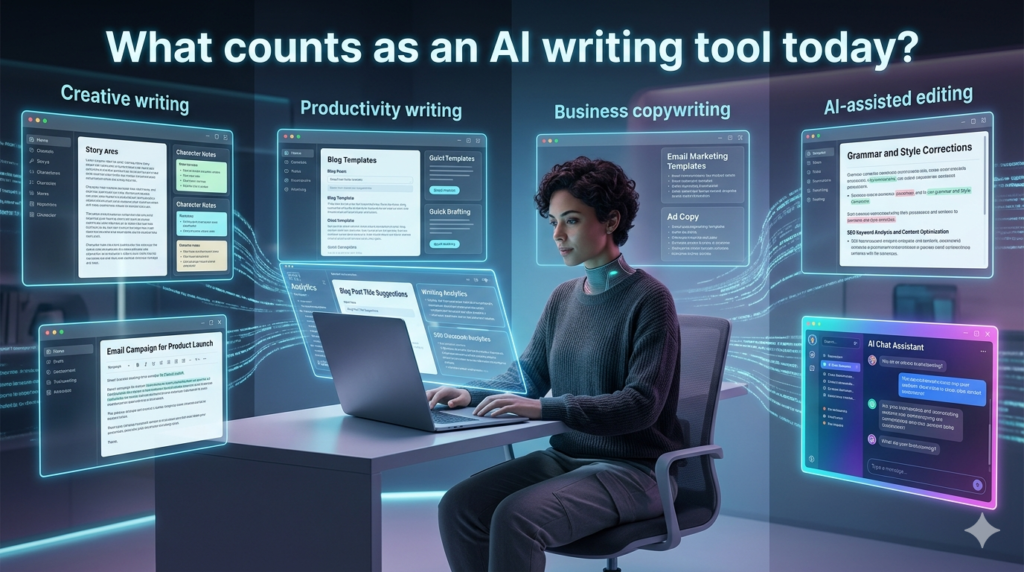
AI writing tool is an umbrella term. In practice it usually means software built around large language models (LLMs) that can generate or transform text based on prompts. Depending on the product, that can include:
- Draft generation: (blogs, landing pages, email sequences, social captions)
- Rewriting and paraphrasing: (tone shifts, shortening, simplifying)
- Editing support: (grammar, style, clarity suggestions)
- SEO assistance: (keyword ideas, outlines, meta descriptions)
- Content repurposing: (turn a webinar into a blog + LinkedIn posts + newsletter)
Some tools operate as a standalone editor; others live inside Google Docs, Word, Slack, or CMS platforms. A growing number combine generation with brand voice training, content templates, and team workflows like approvals and version history.
The real strengths of AI writing tools (when used well)
1) Speeding up the “messy middle”
Most writing time isn’t spent typing final sentences it’s spent organizing thoughts, building structure, and overcoming the friction between ideas and a coherent draft.
AI writing tools are genuinely useful at:
- turning bullet points into a readable first pass
- proposing outlines and section headings
- generating alternatives when a paragraph feels stuck
- summarizing long notes into something you can shape
Think of it less like “autopilot” and more like an intern who can produce unlimited rough drafts. You still direct.
2) Format-shifting: one idea, many deliverables
A practical use case is repurposing. For example, a mid-sized SaaS company might have one strong quarterly report and need:
- a blog post version for SEO
- an executive summary for email
- three LinkedIn posts
- sales enablement snippets for reps
AI can do the initial transformation quickly. A human still needs to verify the claims, align with messaging, and make it sound like the company not like the internet.
3) Plain-language rewrites for accessibility
AI tools are surprisingly helpful at simplifying dense content. If you’ve got policy, legal, healthcare, or technical material, you can use AI to generate a plain English version then have a domain expert review it. Done responsibly, this can make content more inclusive and reduce misunderstanding.
4) Brainstorming that doesn’t get tired
Need subject lines, hooks, FAQs, counterarguments, or angle variations? AI writing tools are great at producing options. Not all of them will be good but ten mediocre ideas is often the fastest path to “one good one.”
Where AI writing tools fall short (and why people get burned)
1) Confident errors (hallucinations)
LLMs can produce text that sounds correct while being wrong statistics, citations, product details, timelines, even basic definitions. If your workflow doesn’t include verification, this is the fastest way to publish misinformation with a professional tone.
If accuracy matters (finance, medical, legal, safety, compliance), AI output needs strict fact-checking and often shouldn’t be used for final claims at all.
2) Generic voice and “same-y” content
Search engines and readers are getting better at recognizing content that feels mass-produced: safe phrasing, predictable structure, bland transitions, and zero lived specificity.
If you rely on AI to create final drafts without strong editing and unique insight, you risk:
- lower engagement (people bounce)
- weaker brand trust
- content that doesn’t earn links or citations
- pages that don’t differentiate in competitive SERPs
3) SEO pitfalls: optimization without usefulness
Many AI writing tools can produce SEO content quickly headings, keywords, meta tags, even internal link suggestions. But SEO in 2026 is still anchored to usefulness and credibility. Pages that merely match keywords without adding original value tend to plateau.
The best-performing AI-assisted content usually includes:
- first-hand experience (what you tested, learned, measured)
- original examples, templates, screenshots, or step-by-steps
- nuanced comparisons and trade-offs
- updated context and limitations
4) Privacy and data leakage risks
If you paste sensitive information (customer data, financials, internal strategy, unreleased product details) into a third-party tool, you may violate contracts or policies. Even when vendors offer enterprise safeguards, you need to understand:
- what data is stored
- how it’s used
- retention policies
- access controls for your team
For regulated industries, involve legal and security early.
How to choose the right AI writing tool (a practical checklist)

When teams ask “Which AI writing tool should we use?”, the honest answer is: it depends on your risk tolerance and your workflow. Here’s what matters more than flashy demos:
- Quality + controllability
- Can you steer tone, format, reading level?
- Does it follow a structured brief well?
- Source handling
- Can it ground writing in provided docs/URLs?
- Can it quote sources accurately (and show them)?
- Brand voice support
- Style guides, reusable prompts, do/don’t rules
- Examples of your existing content baked into workflows
- Team features
- Collaboration, approvals, versioning, audit trails
- Security posture
- Enterprise options, data isolation, admin controls
- Integration
- Works where you write: Docs, Word, Notion, CMS, Jira, etc.
Cost matters but the expensive mistake is publishing content that creates legal risk or erodes trust.
A workflow that keeps humans in charge (and content credible)
Here’s a simple process that scales:
- Start with a real brief
- audience, intent, primary keyword, angle, what good looks like
- Generate an outline first
- don’t accept a 1,500-word draft right away
- Draft in sections
- keep the model focused; reduce wandering and fluff
- Add what AI can’t know
- your data, your screenshots, your examples, your policies, your product reality
- Fact-check everything
- names, dates, stats, definitions, claims, quotes
- Edit for voice
- cut filler, vary rhythm, add specificity and opinion where appropriate
- SEO pass last
- align headings, add internal links, tighten metadata
- Publish + measure
- track rankings, time on page, conversions, feedback; update regularly
Used like this, AI writing tools become leverage not a replacement for judgment.
Ethical considerations (worth getting right)
A few guardrails help teams avoid reputational damage:
- Don’t fabricate sources or citations: If a tool invents a study, it’s on you.
- Be careful with expert claims: Don’t imply credentials you don’t have.
- Respect privacy: Treat prompts like they could be reviewed.
- Avoid plagiarism-by-proxy: Even if text is “new,” it can mirror existing phrasing. Use originality checks and editorial scrutiny.
The bottom line
AI writing tools are best viewed as accelerators for drafting, repurposing, and editing not as a substitute for subject-matter expertise or accountability. The organizations getting the most value aren’t the ones publishing the most AI content; they’re the ones using AI to free up humans for what actually differentiates: insight, taste, accuracy, and trust.
FAQs
Q: Are AI writing tools good for SEO content?
A: Yes if you use them to speed up drafting and outlining, then add original value and human editing. Purely AI-generated pages often struggle to stand out.
Q: Can AI writing tools replace human writers?
A: They can replace some routine writing tasks, but strong content still needs strategy, expertise, verification, and a distinctive voice.
Q: Do AI writing tools produce plagiarism?
A: They can generate text similar to existing content. Use originality checks and edit heavily, especially for competitive topics.
Q: What’s the biggest risk when using AI writing tools?
A: Publishing confident inaccuracies. Fact-checking and source control are non-negotiable for credible content.
Q: How do I keep my brand voice consistent with AI?
A: Use a style guide, provide examples of past content, build reusable prompts, and require a human editor to do a final voice pass.
