
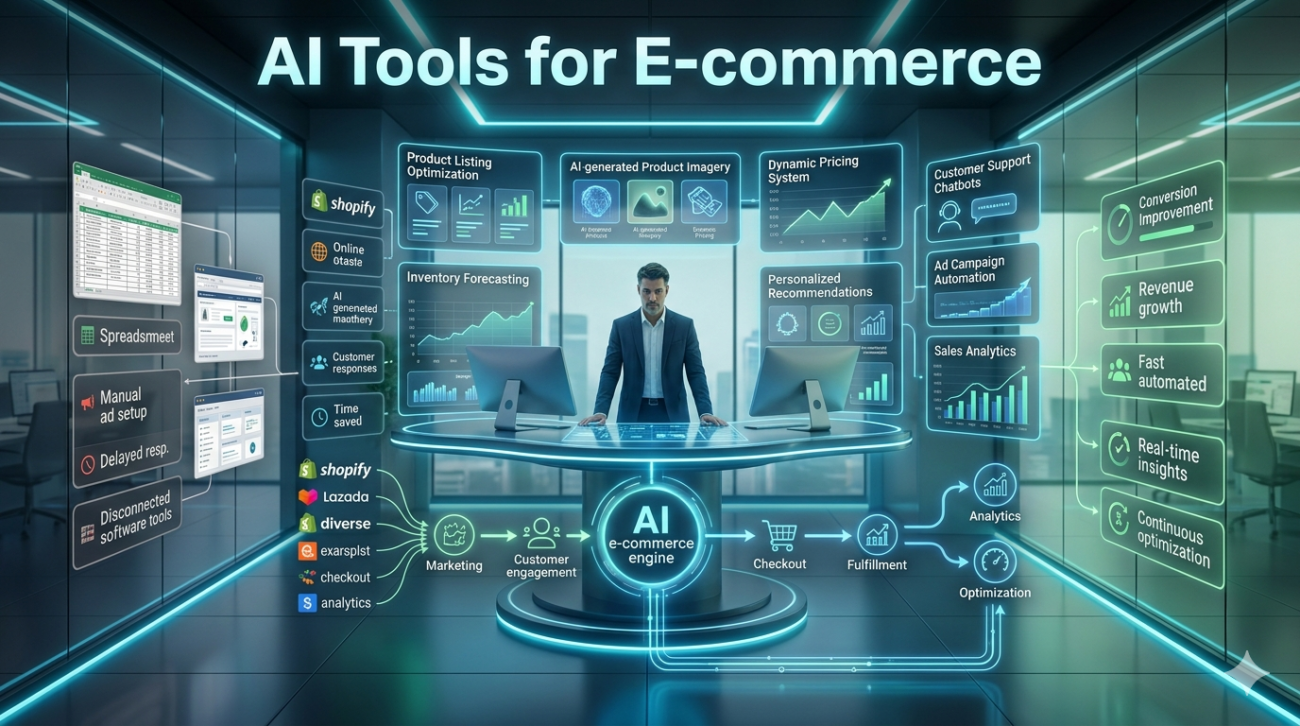
The landscape of online retail has shifted dramatically in recent years, and if you’re running an e-commerce business today, you’ve probably noticed that the tools available now barely resemble what existed even five years ago. Artificial intelligence has moved from being a buzzword to an essential component of daily operations, reshaping everything from how customers discover products to how businesses manage their supply chains. I remember speaking with a small business owner last year who told me she was skeptical about AI tools initially.
I thought it was just another expensive tech trend, she said. “But once I integrated an AI-powered recommendation engine, our average order value jumped by nearly 18% within two months. Now I can’t imagine running the business without it. Her experience mirrors what countless e-commerce operators have discovered: when used strategically, AI tools deliver measurable results that impact the bottom line.
Understanding the AI Tool Ecosystem in E-commerce
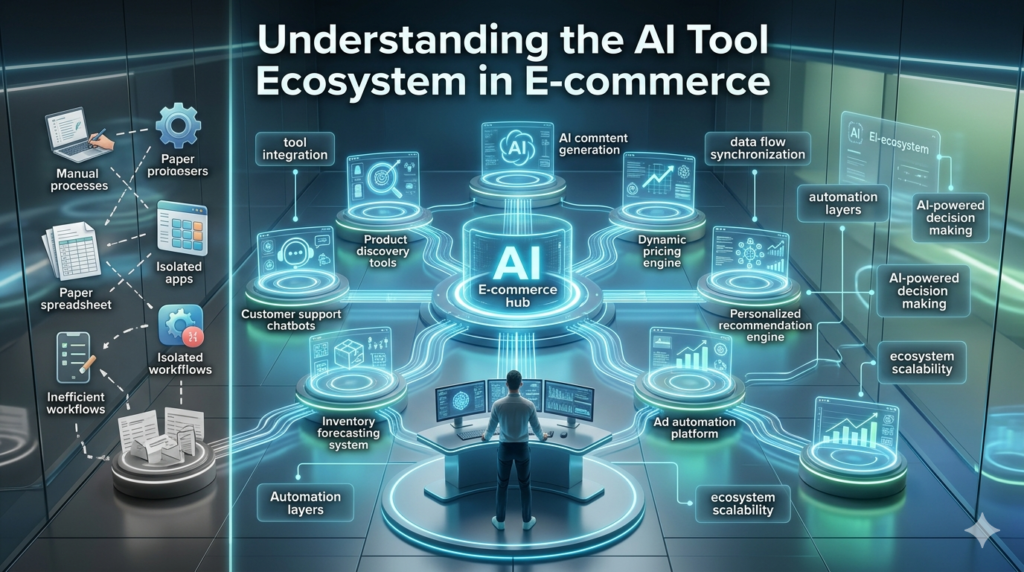
The term AI tools for e-commerce actually encompasses a diverse range of technologies, each serving different functions within the online retail ecosystem. Rather than viewing AI as a single solution, it helps to think of it as a collection of specialized tools that can be deployed strategically across various touchpoints of your business.
Product Discovery and Search Optimization
One of the most impactful applications has been in how customers find products on your site. Traditional keyword-based search often fails when customers use colloquial language or aren’t sure exactly what they’re looking for. AI-powered search tools solve this problem by understanding intent, context, and even visual similarity. Take visual search capabilities, for instance. A customer might see a jacket in a magazine and want to find something similar online. With AI, they can simply upload an image, and the system will return products that match the visual characteristics even if the colors, patterns, or materials differ slightly from what they uploaded.
Retail giants like ASOS have been using this technology to reduce search abandonment and increase conversion rates significantly. Natural language processing has also transformed product recommendations. Instead of relying solely on purchase history, modern recommendation engines analyze browsing behavior, time spent on pages, and even how customers scroll through product images to predict what they might want next. The result feels less like a pushy sales tactic and more like having a knowledgeable sales associate who understands your preferences.
Customer Service Revolution
The chatbot revolution in e-commerce has evolved far beyond simple scripted responses. Today’s AI-powered customer service tools can handle complex inquiries, process returns, and provide personalized support around the clock. What makes this particularly valuable for smaller businesses is that it levels the playing field previously, only large enterprises with massive customer service teams could offer instant support at any hour. One of my clients, who runs a specialty home goods store, implemented an AI chatbot last year. Initially, she worried it would feel impersonal. Instead, she found that customers appreciated getting immediate responses, especially for order tracking and basic product questions.
Her team now handles only the complex issues that require human empathy and problem-solving, while the AI handles the volume. The transformation freed up her staff to focus on building customer relationships rather than drowning in routine inquiries. Voice assistants and messaging platform integrations have expanded this further. Customers can now interact with brands through WhatsApp, Facebook Messenger, or even voice commands, with AI managing the conversation seamlessly across channels.
Inventory and Operations Management
Behind the scenes, AI has become invaluable for managing the operational complexity that comes with running an online store. Inventory management systems powered by machine learning can predict demand with surprising accuracy, taking into account seasonal trends, marketing campaigns, and even external factors like weather forecasts or local events. This predictive capability helps businesses maintain optimal stock levels reducing both stock outs that cost sales and overstock situations that tie up capital. For businesses dealing with thousands of SKUs, the difference between AI-informed and traditional reorder point decisions can mean millions in recovered revenue over time.
Supply chain optimization extends beyond just having enough stock. AI tools can identify the most efficient shipping routes, predict delivery delays, and even optimize warehouse operations by analyzing patterns in order fulfillment. These systems continuously learn from data, becoming more accurate as they process more information about your specific business operations.
Dynamic Pricing Strategies
Pricing optimization represents another area where AI delivers significant impact. Rather than static pricing tables, AI-driven dynamic pricing systems continuously adjust prices based on competitor pricing, demand patterns, inventory levels, and even customer behavior. Airlines and hotel companies pioneered this approach, but it’s now accessible to retailers of all sizes.
The key to successful implementation lies in setting appropriate boundaries. AI can adjust prices within ranges you define, ensuring that discounts still maintain profitability while responding to market conditions in real-time. This isn’t about being the cheapest option it’s about finding the sweet spot where price aligns with demand and customer perceived value.
Marketing and Personalization at Scale
Perhaps no area has seen more transformation than e-commerce marketing. AI tools now power highly personalized email campaigns, targeted advertising, and content strategies that would be impossible to execute manually at scale. Product description generation, while controversial, has become practical with large language models. For businesses with extensive catalogs, AI can create unique, SEO-friendly product descriptions that maintain brand voice while highlighting key features. The important caveat here is that these outputs require human review AI occasionally produces inaccurate specifications or generic-sounding content that fails to capture a product’s unique selling points.
Image recognition and generation have opened new creative possibilities too. AI can automatically generate product lifestyle images, remove backgrounds, or create variations for A/B testing campaigns. This accelerates creative workflows significantly, though ethical considerations around disclosure and authenticity remain important to navigate thoughtfully.
Building Trust Through Responsible Implementation

With all the excitement around AI capabilities, I think it’s crucial to address the limitations and ethical considerations that responsible e-commerce operators should keep in mind. Data privacy concerns are legitimate. AI systems require data to function effectively, and customers are increasingly aware of how their information is used. Being transparent about data practices, offering opt-in rather than opt-out approaches for personalization, and providing genuine value in exchange for data access builds trust rather than eroding it.
The risk of algorithmic bias exists in any AI system. Recommendation engines might inadvertently steer customers toward higher-priced items, or pricing algorithms could disadvantage certain customer segments. Regular auditing and diverse testing scenarios help identify and address these issues before they damage customer relationships or brand reputation.
Looking Ahead
The trajectory of AI in e-commerce points toward increasingly seamless integration. We’re moving toward ambient commerce experiences where AI assists customers throughout their decision journey without requiring explicit prompts anticipating needs based on context, preferences, and behavior patterns. For businesses considering which AI tools to adopt, my advice is to start with a clear problem you’re trying to solve rather than adopting technology for its own sake.
Evaluate tools based on how well they integrate with your existing systems, the quality of support and documentation available, and how they align with your customer experience vision. The businesses that will thrive aren’t necessarily those with the most sophisticated AI systems rather, those that thoughtfully implement technology to enhance the human elements of commerce while respecting boundaries and building genuine value for customers.
FAQs
Q: What AI tools are most essential for small e-commerce businesses?
A: For small businesses, AI-powered chatbots for customer service, product recommendation engines, and email marketing automation tools typically offer the best return on investment. These handle high-volume, repetitive tasks that would otherwise require significant manual effort.
Q: How much does it cost to implement AI tools in an e-commerce store?
A: Costs vary widely depending on the complexity and provider. Basic AI tools might start at $50-100 per month, while enterprise-level solutions can run into thousands. Many platforms offer built-in AI features within their existing subscription tiers, making advanced capabilities accessible without additional investment.
Q: Can AI completely replace human customer service agents?
A: No, and it shouldn’t attempt to. AI handles routine inquiries effectively, but complex issues, emotional situations, and relationship-building still require human intervention. The best approach uses AI to handle volume while escalating nuanced issues to trained human agents.
Q: Are AI-generated product descriptions reliable?
A: AI-generated descriptions require human oversight to ensure accuracy, especially for technical specifications. They’re best used as a starting point that human editors refine rather than as final content published without review.
Q: How do AI tools affect e-commerce SEO?
A: AI can help create optimized content at scale, but quality and originality matter more than pure volume. Search engines increasingly prioritize user experience signals, so AI-generated content must genuinely help customers make informed decisions rather than just targeting keywords.
Q: What are the risks of relying heavily on AI for pricing?
A: Over-reliance on dynamic pricing without proper safeguards can damage customer trust if price swings are too dramatic or appear unfair. Setting ethical boundaries and clearly defined pricing rules helps prevent negative outcomes while capturing AI’s optimization benefits.
