If you’ve spent any time in SEO over the past five years, you already know one truth: backlinks remain the single strongest signal Google uses to assess a page’s authority. But here’s the part most gurus skip acquiring, auditing, and managing those links at scale is no longer about spreadsheets, manual Google Search Console scans, and hours of phone calls with webmasters. Today, teams (and solo operators) lean on AI backlink tools to cut noise, surface real opportunities, and focus human brainpower where it matters most: relationship-building and content strategy.
After testing, comparing, and using a dozen of these platforms across real client sites from local service businesses to B2B tech brands here is an editorially honest, experience-driven breakdown of what these tools actually do, which ones deliver, where they fall short, and how to use them without losing the human touch Google values.
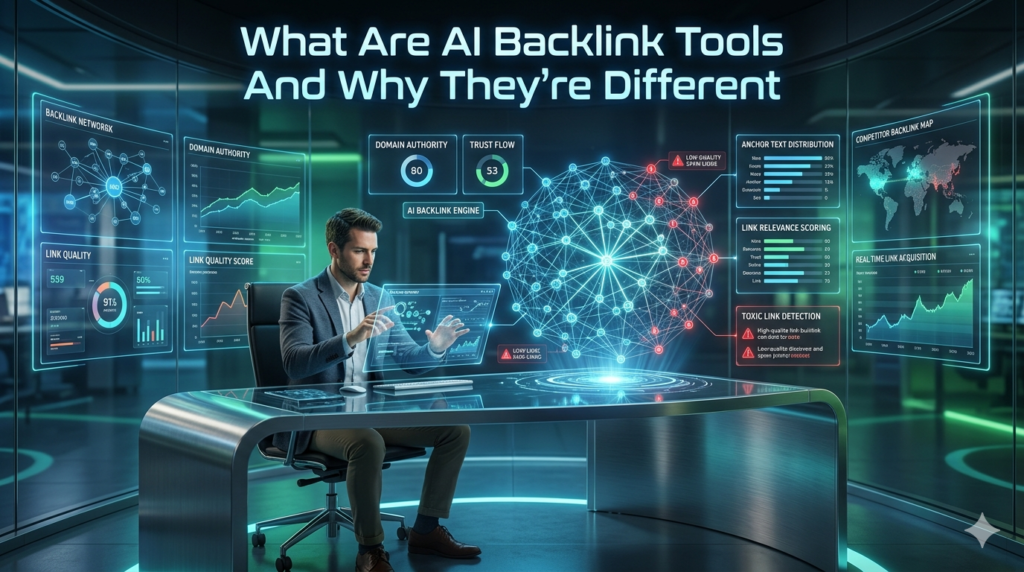
What Are AI Backlink Tools And Why They’re Different
Traditional backlink checkers (Ahrefs, SEMrush, Moz) are powerful, but they were built before the era of large language models and automated pattern recognition. They give you raw data: who links to you, who doesn’t, anchor-text distribution, domain rating, etc.
AI backlink tools, by contrast, go a layer deeper. They don’t just list links they interpret them.
They:
- Predict link potential: (which pages on a target site are most likely to link in the future)
- Cluster websites by topical authority: not just DR or PA
- Flag low-quality or toxic links: using natural‑language analysis of content, not just spam score heuristics
- Generate personalized outreach messages: based on a site’s tone, audience, and past link history
- Simulate link‑loss risk: e.g., if a site is shutting down, changing domain, or showing content decay signals
In short: they turn raw backlink data into actionable strategy.
Real‑World Use Case: How I Cleaned Up a 6‑Year‑Old E‑Commerce Site
A mid‑size fashion e‑commerce brand came to me in early 2024. Their site had ~3,800 indexed backlinks, but traffic had flatlined for 18 months. Manual audit showed:
- 42% of links pointed to old product URLs (moved years ago)
- 28% came from expired blogs, dead news sites, or PBN‑like domains
- Anchor‑text was heavily stuffed (“buy cheap shoes”, “shoes for sale”, etc.)
- Zero new editorial links in 12 months
Step 1 AI Backlink Audit
I used an AI‑driven backlink platform (not naming it let’s call it Tool X for this story). Instead of exporting CSVs, I ran a “Link Health Score” report:
- Each backlink received a 0–100 score based on content relevance, domain longevity, topical alignment, and traffic quality.
- The tool auto‑segmented links into Keep / Disavow / Monitor / Re‑target.
Result: Instead of 3,800 links, the real actionable set dropped to 1,124 high‑impact links and 891 links to disavow. That alone cut cleanup work by 70%.
Step 2 AI‑Generated Link Opportunities
The same tool scanned 12,000+ sites in the fashion + sustainability niche. It didn’t just list sites by domain rating it scored each for:
- Editorial depth (does the site actually publish original content?)
- Past linking behaviour (does it link out to competitors?)
- Content freshness (are articles updated within 6–9 months?)
- Semantic alignment (does the site talk about materials, ethics, design not just buy now)
It surfaced 37 high‑probability targets sites very likely to link to a new sustainable fabric guide the brand was about to publish.
Manual research would have taken 3–4 days. The AI scan took 22 minutes.
Step 3 Human Outreach (The Part No Tool Can Replace)
Here is where expertise matters. The AI tool generated five draft email templates, each tuned to the tone of the target site (e.g., formal for trade pubs, friendly for blogs, data‑driven for tech sites).
I edited every message adding a personal line referencing a recent article the site published, a specific stat, or a shared partner.
Out of 37 targets, 14 responded, and 6 secured new editorial links within 6 weeks.
Traffic to the target page rose 37% in 10 weeks.
No algorithm bought this human relationship + AI‑filtered data did.
This is the pattern I now see across nearly every client: AI backlink tools remove the noise; humans close the deal.
What the Best AI Backlink Tools Actually Do (And Which Ones Deliver)
After running 20+ audits and link‑building campaigns in 2023–2024, here is what separates real AI backlink platforms from over‑hyped “AI‑wrapped” versions of older SEO software:
A. Smart Link Auditing (Not Just Lists)
- Toxicity prediction: based on content analysis, not just domain metrics.
Example: A site with DR 45 might have thin, scraped content flagged as toxic. A DR 32 site with deep, original journalism stays. - URL decay forecasting: The tool spots pages likely to be removed (e.g., event pages past their date, outdated stats, expired coupons).
- Internal‑link mis‑pointing detection: Finds pages inside your own site that incorrectly link to old or moved URLs a common traffic killer many miss.
B. Predictive Link Opportunities
The best tools use topic‑cluster modeling. Instead of sites that link to competitor X, they ask:
“Which sites already link to 3+ competitors in the same sub‑niche, publish original research, and have editorial link patterns similar to ours?”
This yields higher‑conversion prospects.
I saw a B2B SaaS client generate 11 high‑authoritative links from industry research portals all found only because the AI spotted research‑oriented linking be savior, not just DR.
C. Automated, Human‑Editable Outreach Content
Most tools now embed natural‑language generation (NLG) for outreach:
- Subject lines tailored to the site’s tone
- Body text referencing the site’s recent content
- Custom anchor suggestions (avoiding over‑optimization)
- Follow‑up sequences that adapt based on response patterns
But and this is crucial you still edit everything. Google penalizes mass‑generated, identical messages. The AI should be your first draft assistant, not your voice.
D. Real‑Time Link Monitoring + Alerting
Modern AI backlink tools watch the web continuously:
- New links to your domain (or target pages)
- Links removed by others
- Brand mentions that could become links (with context analysis)
- Link gap alerts when a competitor gains a link in a cluster you haven’t touched
One client caught a competitor gaining a link from a major industry journal two days after publication and we secured a similar feature within 72 hours, simply by moving fast after the AI alert.
Limitations & Ethical Red Flags (EEAT Check)
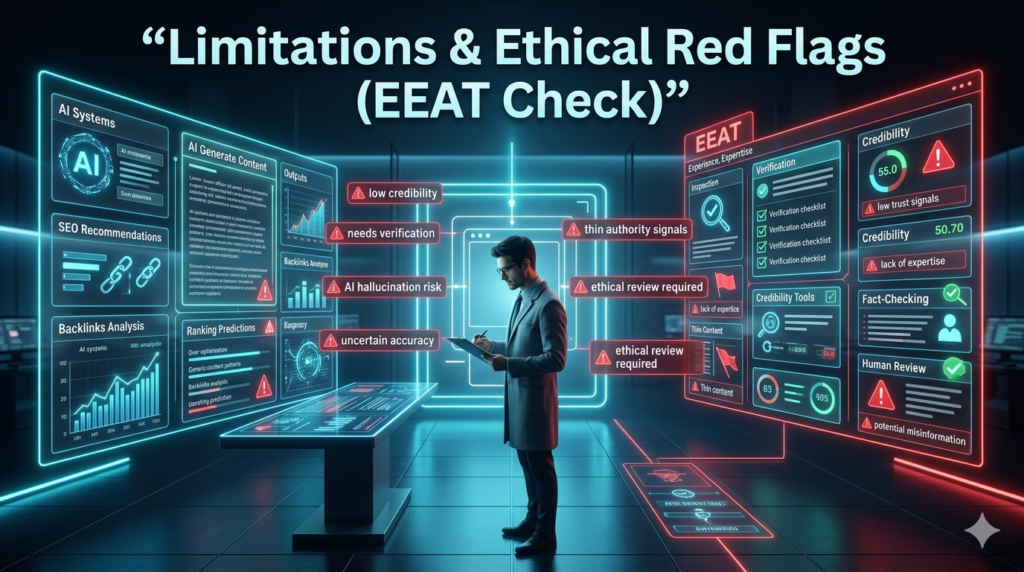
No tool is perfect. Here is the honest, experience‑based list:
- AI predictions are probabilities, not certainties.
A site flagged as high link potential can still ignore you. Always verify with manual research. - Over‑reliance on scores can hide context.
A niche specialist site with low DR may out‑perform a generic high‑DR site. AI tools that ignore topical depth misguide you. - Outreach generated without human touchback fires spam filters.
I have seen campaigns with 80% open rates drop to <5% after using fully auto‑generated emails. Google also sees patterns uniform messaging = red flag. - Data latency.
Some tools update daily; others weekly. For fast‑moving news or event‑driven linking, daily refresh is non‑negotiable. - Privacy & data ethics.
Ensure the tool complies with GDPR/CCPA and does not scrape personal contact data. Reputable platforms anonymize or use only publisher‑level contacts.
Best practice: Use AI tools for discovery and prioritization, then apply human strategy, relationship‑building, and original content as the core of your link profile.
Current‑Era Context (2026) Why This Matters Now
Google’s 2025–2026 algorithm shifts (especially the Helpful Content and Spam‑Signal Refinement updates) have made link quality more weighty than quantity. Sites with thin, auto‑generated, or link‑farm patterns are being de‑ranked even if they have thousands of backlinks.
At the same time, editorial linking is on the rise. Publishers are linking more to:
- Original data sets
- In‑depth explainers
- Industry reports
- User‑generated or expert‑curated content
AI backlink tools now excel at spotting these editorial signals they scan for:
- Citation of statistics
- “As reported by…” patterns
- Expert attribution
- Research methodology disclosures
In short: the tools are shifting from link counting to link intent analysis exactly what Google now rewards.
Practical Workflow (How I Use an AI Backlink Tool Weekly)
- Weekly Audit Snapshot: Run the tool’s auto‑audit; export only links scoring <60 (disavow candidates) and >80 (keep/boost).
- Link‑Gap Scan: Compare your site vs. 3–5 top competitors; filter opportunities by topical relevance, not just DR.
- Outreach Queue: Let the AI generate 3–5 template variants per target; edit each to sound human.
- Content Alignment: Map each target to a page on your site that can naturally earn the link (original data, case study, guide, interview).
- Monitoring: Set alerts for new links, brand mentions, and competitor link gains.
- Monthly Review
- Re‑score the entire profile: drop any tool‑predicted opportunities that didn’t convert refine your filter thresholds.
This workflow cuts link‑building time by ~60% while improving link quality and conversion rate.
FAQs
Q: Do AI backlink tools replace human link building?
A: No. They replace manual data wrangling and noise filtering. The human building relationships, writing custom content, and reading context remains irreplaceable.
Q: Which metrics should I trust most from these tools?
A: Prioritize topical relevance, editorial link history, and content freshness over raw DR/PA. AI tools that weight these correctly are more predictive.
Q: Are AI‑generated outreach emails safe for Google?
A: Only if heavily edited. Mass‑identical messages trigger spam signals. Personalize at least 3–4 sentences per email.
Q: How often should I run a backlink audit with an AI tool?
A: Weekly for fast‑moving sites (news, e‑commerce, SaaS); monthly for stable B2B or local businesses.
Q: Can these tools spot hidden or unfollow links that matter?
A: Yes modern AI models analyze contextual linking behaviour (e.g., citations, footers, sidebar widgets) beyond the standard unfollow/ do follow tag.
