
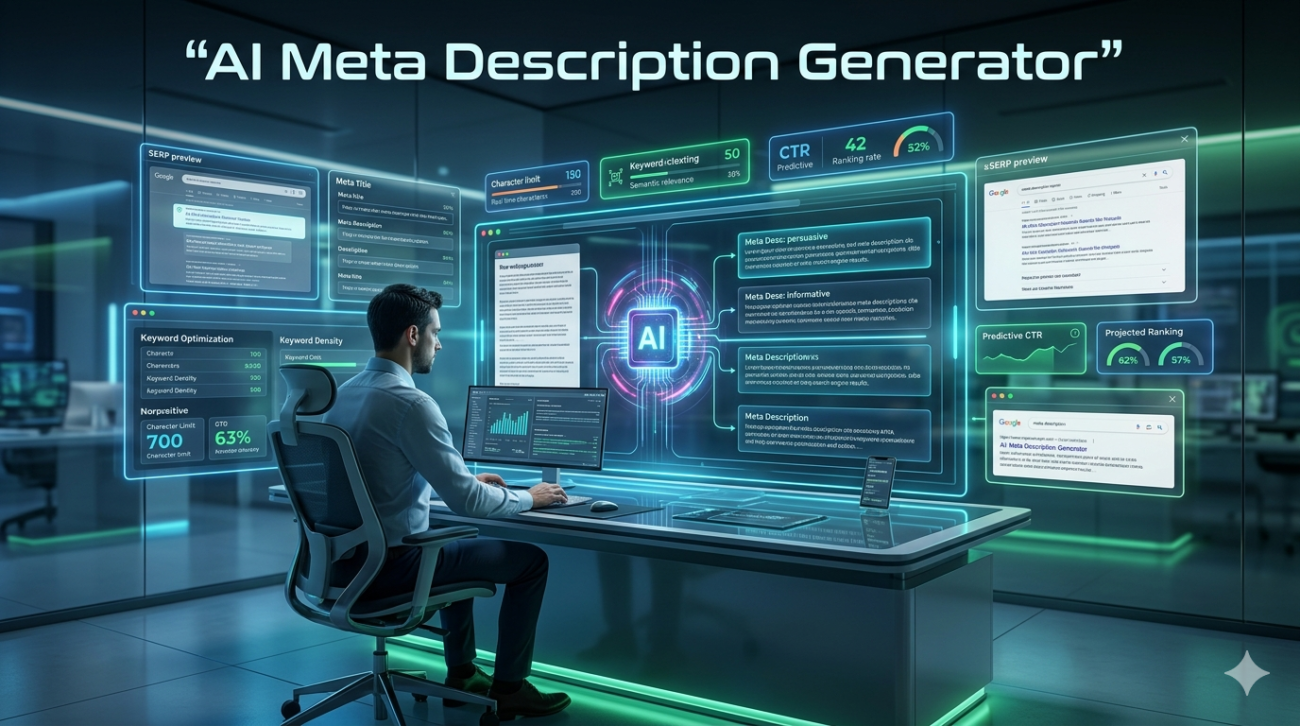
If you have spent any meaningful amount of time in the SEO trenches, you know the specific kind of fatigue that sets in around the fiftieth meta description of a website audit. Writing one compelling, keyword-rich summary of a webpage is easy. Writing five hundred for an sprawling e-commerce catalog or a legacy blog archive is soul-crushing. Historically, this led to two bad outcomes: SEOs either copy-pasting generic boilerplate text across dozens of pages, or leaving the tag blank and praying Google’s automated snippets wouldn’t pull a disjointed navigation menu into the Search Engine Results Pages (SERPs).
Enter the AI meta description generator. Over the past few years, integrating these automated writing assistants into my agency workflows hasn’t just saved time it has fundamentally changed how we approach organic Click-Through Rate (CTR) optimization. But like any powerful tool, using it effectively requires understanding its mechanics, its limitations, and the nuanced art of human oversight.
Why Meta Descriptions Still Matter (The CTR Connection)
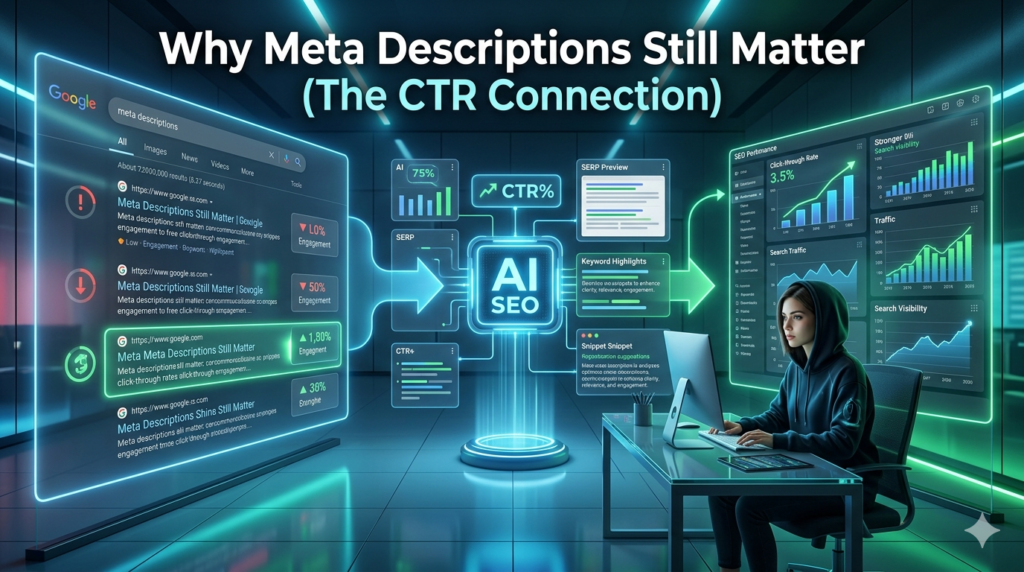
Let’s get one technical reality out of the way: Google confirmed years ago that meta descriptions are not a direct ranking factor. Stuffing them with keywords won’t magically push you from page two to page one. However, they are absolutely critical for user engagement. Your title tag gets searchers to stop scrolling; your meta description convinces them to click. It is your digital storefront billboard.
A well-crafted meta description addresses search intent, offers a clear value proposition, and includes a subtle call to action (CTA) all within a tight limit of roughly 150 to 160 characters. When you multiply that requirement across thousands of landing pages, the value of an AI generator becomes obvious. It removes the friction of the blank page.
How Modern AI Meta Description Generators Actually Work
Early iteration content spinners simply swapped out synonyms, resulting in robotic, unreadable nonsense. Today’s AI meta description generators are built on advanced Large Language Models (LLMs) that understand semantic context. When you feed a quality generator a URL, a page title, or a few target keywords, it performs several micro-tasks in milliseconds:
- Context Extraction: It reads the provided text to understand the core subject and unique selling proposition (USP) of the page.
- Intent Matching: It aligns the tone with the implicit search intent (e.g., transactional for product pages, informational for blog posts).
- Constraint Application: It trims the output to fit within standard pixel/character limits to prevent SERP truncation.
Real-World Case Study: The E-Commerce Migration
Last year, my team oversaw an SEO migration for an independent outdoor gear retailer. They had roughly 1,200 product pages with blank meta descriptions. Manual writing would have taken an estimated 80 billable hours. We deployed an API-driven AI meta description generator, feeding it the product titles, primary categories, and core specs. Within two hours, we had 1,200 distinct, tailored descriptions.
Did we just upload them blindly? Absolutely not. We spent about 12 hours manually reviewing and polishing the outputs. Total time saved: roughly 65 hours. More importantly, year-over-year organic CTR on those product pages increased by 14.2% because searchers were finally seeing compelling product summaries instead of random page snippets.
The “Human in the Loop” Imperative

If there is one piece of advice you take from my experience, let it be this: never automate your SEO strategy end-to-end without human oversight.
While AI generators are fantastic at structure and speed, they suffer from distinct blind spots:
- The Generic Trap: Left to its own devices, AI loves cliché phrasing. If I see “Unlock the power of…” or “Dive into our comprehensive guide…” one more time, I might lose my mind. Humans need to edit out these lazy linguistic crutches.
- Hallucinations: An AI might assume a product comes with free shipping or a lifetime warranty because those phrases commonly appear in e-commerce training data. Publishing false promises in your SERP snippet will tank your conversion rates and build instant user distrust.
- Brand Voice Disconnect: A B2B legal SaaS company requires a very different tone than a boutique skateboard shop. You must prompt the generator specifically for tone, and manually tweak the outputs to ensure brand alignment.
Best Practices for Prompting and Generation
To get publication-ready snippets out of an AI tool, you have to master the input. Garbage in, garbage out. Here is the framework I use when configuring these tools:
Weak Input: Generate a meta description for a page about dog food.
Result: Learn all about the best dog food for your pet. We have high-quality dog food options available for all breeds. Click here to buy now. (Boring, repetitive, exceeds character limits).
Expert Input: Write a concise meta description under 155 characters for organic grain-free puppy food. Target keyword: ‘best grain-free puppy kibble’. Mention our 100% locally sourced ingredients. Tone: Warm and authoritative. End with a subtle CTA.
Result: Give your growing pup the best grain-free puppy kibble made from 100% locally sourced ingredients. Support their health naturally. Shop our blends today! (Punchy, optimized, accurate).
The Ethical and Practical Future
As search engines continue to evolve incorporating generative AI summaries directly into the top of the results the role of traditional metadata is shifting. However, as long as ten blue links and organic listings exist, the meta description remains your best tool for winning the click. Using AI to generate these snippets isn’t cutting corners; it’s working smart.
By automating the heavy lifting of drafting, you free up your mental bandwidth to focus on high-level strategy, technical audits, and user experience. Treat the AI as your tireless drafting intern, act as the rigorous managing editor, and watch your organic traffic scale.
FAQs
Q: Does Google penalize AI-generated meta descriptions?
A: No. Google’s guidelines focus on the quality and helpfulness of content, not how it was created. As long as the meta description accurately reflects the page content and provides a good user experience, there is no penalty for using AI to assist in writing it.
Q: Why does Google sometimes rewrite my meta descriptions anyway?
A: Google rewrites meta descriptions for roughly 60% to 70% of search queries. It does this when it believes a dynamic snippet pulled directly from the page content better answers the specific searcher’s query. Having a strong custom meta description still acts as a vital baseline for your primary targeted keywords.
Q: What is the ideal length for an AI-generated meta description?
A: Aim for 150 to 160 characters for desktop displays, and around 120 characters for mobile displays. It is best practice to front-load your primary keyword and core value proposition in the first 120 characters to ensure safety across all devices.
Q: Can I bulk-generate meta descriptions for an entire website?
A: Yes. Many advanced SEO platforms and standalone AI tools allow you to upload CSV files of URLs and keywords to generate descriptions in bulk. However, you should always perform a manual review of the generated batch to catch factual errors or repetitive phrasing before pushing them live.
